
How Buni’s Wealth Creation Ministry’s Innovative Investments Expand Jobs, Opportunities In Yobe

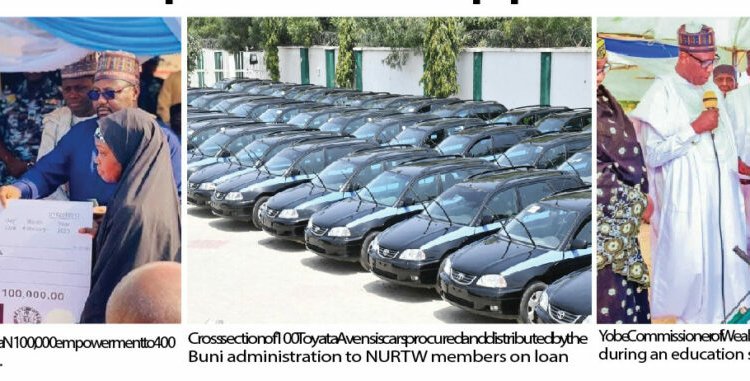
How Buni’s Wealth Creation Ministry’s Innovative Investments Expand Jobs, Opportunities In Yobe
By ALI MUSA YAWALE
In a small neighbourhood in Damaturu, Hauwa Ali no longer waits for handouts. With a grinding machine provided under a state empowerment programme, she now runs a modest business that feeds her family and supports her children’s schooling. What began as a simple intervention has gradually transformed into a steady source of income, restoring not just her livelihood but her dignity.
Her story reflects a broader shift unfolding across Yobe State, one shaped not only by economic policy but by the urgent need to rebuild lives and livelihoods in the aftermath of years of insurgency. At the centre of this effort is Governor Mai Mala Buni’s decision to institutionalise empowerment through the creation of the Ministry of Wealth Creation, Empowerment and Employment Generation.
The establishment of the ministry marked a significant departure from fragmented and short-term empowerment efforts of the past. It introduced a coordinated, policy-driven approach aimed at addressing unemployment, poverty and economic exclusion—key challenges exacerbated by the impact of insurgency on communities, businesses, and local economies.
The pioneer Commissioner of the Ministry was Hon. Abdullahi Bego, who laid the foundation for its operational framework, while the ministry is currently under the leadership of Hon. Aji Yerima Bularafa, who is consolidating and expanding its interventions across the state.
Unlike conventional empowerment schemes, the ministry represents a structured and sustained approach to recovery—one that goes beyond relief to rebuilding economic resilience. At the heart of this approach is a series of innovative investments designed to equip citizens with tools, skills and capital to restart their lives and build lasting livelihoods.
Across multiple sectors, the impact is becoming increasingly visible, touching lives in both urban and rural communities—many of which are still recovering from the disruptions of conflict.
In the transport sector, the distribution of 100 Toyota Avensis taxis to members of road transport workers has provided a reliable means of income for many families. Similarly, 300 tricycles were distributed to youths and members of ACMORAN, creating employment opportunities and improving mobility within towns and villages. The procurement of 200 motorcycles and 160 agro-based tricycles has further expanded access to transportation, particularly in rural areas where restoring movement is essential to economic recovery.
For artisans and small-scale entrepreneurs, the interventions have opened new pathways to self-reliance. No fewer than 500 sewing machines were distributed to fashion designers, enabling them to rebuild their businesses and train apprentices. Barbers, vulcanisers, and GSM and ICT technicians have also benefited from the distribution of working tools, allowing them to restore services disrupted by years of instability.
Women, especially widows and vulnerable groups affected by the insurgency, have emerged as major beneficiaries of the programme. The distribution of 1,000 grinding machines has empowered many to restart small-scale businesses within their communities. For food vendors, the provision of 400 sets of kitchen utensils, alongside 1,780 gallons of cooking oil and 4,500 units of advanced charcoal stoves, has enhanced productivity and reduced operational costs.
In addition, the provision of hairdressing and barbing salon equipment has created new opportunities for women and youths to acquire skills and rebuild their economic independence.
Agriculture, a backbone of Yobe’s economy that was significantly disrupted by insecurity, has also received targeted support. Through the distribution of 2,800 water pumps, irrigation farming has been strengthened, enabling farmers to return to their fields and sustain production beyond the rainy season. Training programmes in poultry and fish farming, supported with starter kits, have equipped hundreds of beneficiaries with practical skills to re-enter the agricultural value chain.
Beyond physical tools and equipment, the ministry has made deliberate efforts to promote financial inclusion and enterprise development. Over 500 traders have been supported in businesses such as POS operations, lube bay services, perfumery, and cosmetics. Micro enterprises have also received direct financial support of N50,000, providing much-needed capital for individuals seeking to rebuild their livelihoods.
To ensure sustainability and effective planning, the government has developed a comprehensive database of micro and small businesses across the 178 political wards of the state. This initiative is expected to enhance data-driven decision-making, improve targeting of beneficiaries, and strengthen long-term recovery efforts.
Read Also: A CONSENSUS FOR CONTINUITY: The case for Baba Malam Wali in Yobe…
Inclusivity remains a central pillar of the ministry’s interventions. No fewer than 500 persons living with disabilities—many of whom were disproportionately affected by the crisis—have been supported with wheelchairs, enabling greater mobility and participation in economic and social activities.
Additional interventions, including the distribution of 500 units of chest freezers and training in shoemaking for beneficiaries across the 17 local government areas, are further widening access to opportunities and strengthening grassroots recovery.
Beneficiaries and community leaders across the 17 local government areas say what distinguishes the ministry’s approach is not just the scale of interventions, but the deliberate effort to rebuild livelihoods, restore dignity, and create an ecosystem where individuals can generate income and sustain their families.
To further underscore the impact of the initiative, the Commissioner for Wealth Creation, Empowerment and Employment Generation, Hon. Aji Yerima Bularafa, said the ministry’s interventions are deliberately designed to create sustainable livelihoods rather than temporary relief.
“Our focus is to empower people with the tools, skills and support they need to stand on their own,” he said. “These interventions are not just about today; they are about building a future where our people can create wealth, support their families, and contribute meaningfully to the state’s economy.”
For beneficiaries like Hauwa Ali, the impact is deeply personal. Beyond the income she now earns, there is a renewed sense of purpose and independence.
“I can now provide for my children and support my family,” she said. “This opportunity has changed my life.”
Across Yobe’s 17 local government areas, the results are becoming increasingly visible—youths gaining skills, women rebuilding businesses, and families finding stability where there was once uncertainty and disruption. What is emerging is not just a series of empowerment programmes, but a deliberate pathway to recovery and long-term economic resilience.
In the end, the true measure of Buni’s Wealth Creation Ministry may not lie in the number of items distributed, but in the thousands of lives rebuilt—one tool, one skill, and one opportunity at a time.
