
Bingham VC seeks global collaboration to improve Nigeria’s surgical care

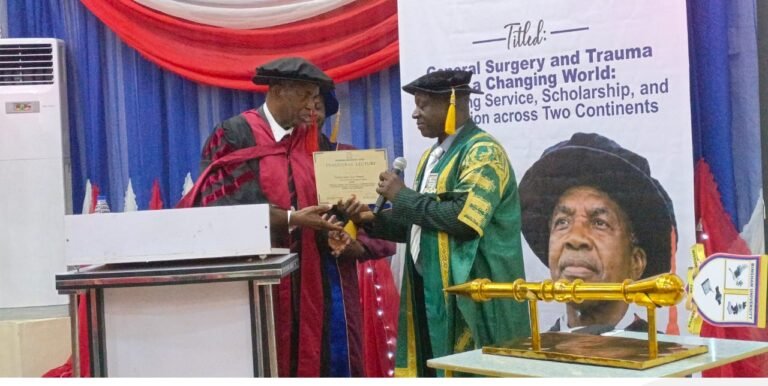
Bingham VC seeks global collaboration to improve Nigeria’s surgical care
The Vice-Chancellor of Bingham University, Prof. Haruna Ayuba, has called for strong global collaboration to improve surgical care in Nigeria.
Ayuba made the call at the 15th Inaugural Lecture of the University on Tuesday in Karu, Nasarawa State.
The call comes amid persistent challenges confronting surgical care in Nigeria, including delayed hospital presentation, inadequate access to diagnostic and operative resources, and weaknesses in emergency referral systems.
The lecture was delivered by Prof. Edwin Oseni-Momodu, a Professor of General Surgery and Trauma in the Department of Surgery of the University.
The inaugural lecture is entitled: “General Surgery and Trauma in a Changing World: Advancing Service, Scholarship and Innovation Across Two Continents.”
Ayuba emphasised that international collaboration, sustained investment and innovation would help to improve surgical care and address inequalities in healthcare delivery.
He warned that Nigeria must shift from a healthcare system dependent on individual doctors to one backed by strong institutions, functional trauma networks and reliable emergency response mechanisms.
The Vice-Chancellor added that differences in healthcare resources, disease patterns and health systems have made international partnerships essential for improving medical practice and developing solutions tailored to local needs.
According to him, changing disease patterns, unequal access to healthcare and emerging technologies are reshaping surgical needs globally, requiring healthcare professionals to look beyond clinical expertise.
He stressed that research, interdisciplinary collaboration and the exchange of knowledge could strengthen healthcare delivery and make surgical services more accessible.
The Vice-Chancellor said the university remained committed to research that translates academic knowledge into practical benefits for society.
Furthermore, the inaugural lecturer, Oseni-Momodu, in his lecture, argued that lasting improvements in surgical outcomes would depend not merely on medical expertise and technological advancement.
According to him, lasting improvement would depend on building healthcare institutions capable of consistently delivering safe, timely and accessible treatment.
Oseni-Momodu emphasised that preventable deaths could be reduced if Nigeria strengthened its trauma systems, improved emergency referrals, expanded surgical capacity at district and rural hospitals, invested in locally relevant research and made patient safety a priority.
Reflecting on his professional journey, the professor said his six years of specialist surgical training in Germany provided a foundation in precision, discipline and clinical judgment.
He added that his decades of practice in Nigeria taught him adaptability and resourcefulness in the face of healthcare system constraints.
Read Also: Bariga LCDA begins 2027 budget consultations, prioritise…
He stressed that the experience reinforced his conviction that surgical excellence must be supported by effective healthcare systems rather than left to the ingenuity and sacrifices of individual practitioners.
“Nigeria’s future surgical care must be built around institutions, structures and processes that enable good outcomes consistently, regardless of the individual doctor attending to a patient,” he said.
He called for stronger district-level surgical services, noting that rural and district hospitals often represent the first point of contact for patients experiencing life-threatening emergencies.
He said healthcare workers at these facilities should be equipped to recognise emergencies, initiate resuscitation, perform essential life-saving procedures within their competence and arrange prompt referrals where more specialised care was required.
Oseni-Momodu cautioned that sophisticated equipment could not replace clinical judgment, disciplined assessment and timely intervention, while acknowledging advances in diagnostic imaging, critical care, minimally invasive surgery and other medical technologies.
“The operating theatre became a classroom, ward rounds became opportunities for mentorship, and difficult clinical cases became potential subjects for research and academic inquiry,” he said.
He advised that the responsibilities of modern surgeons extend beyond performing operations to include teaching, research, mentorship, advocacy, institutional leadership and participation in healthcare policy.
He identified discipline, sound judgment, compassion, teamwork, integrity, lifelong learning and investment in younger professionals as lessons that had defined his career.
He maintained that a surgeon’s contribution should not be measured exclusively by the number or complexity of operations performed, but also by the lives improved, professionals mentored and institutions strengthened.
“The true measure of surgical success is not what we accomplish individually, but the lives improved through the institutions, values, and systems we leave behind,” he said.
