
FG, group boosts cassava, ginger, sesame industrialisation

FG, group boosts cassava, ginger, sesame industrialisation
The Federal Ministry of Agriculture and Food Security and the Pan African Alliance of Small and Medium Industries (PAOSMI) have resolved to collaborate to accelerate agro-industrialisation in Nigeria.
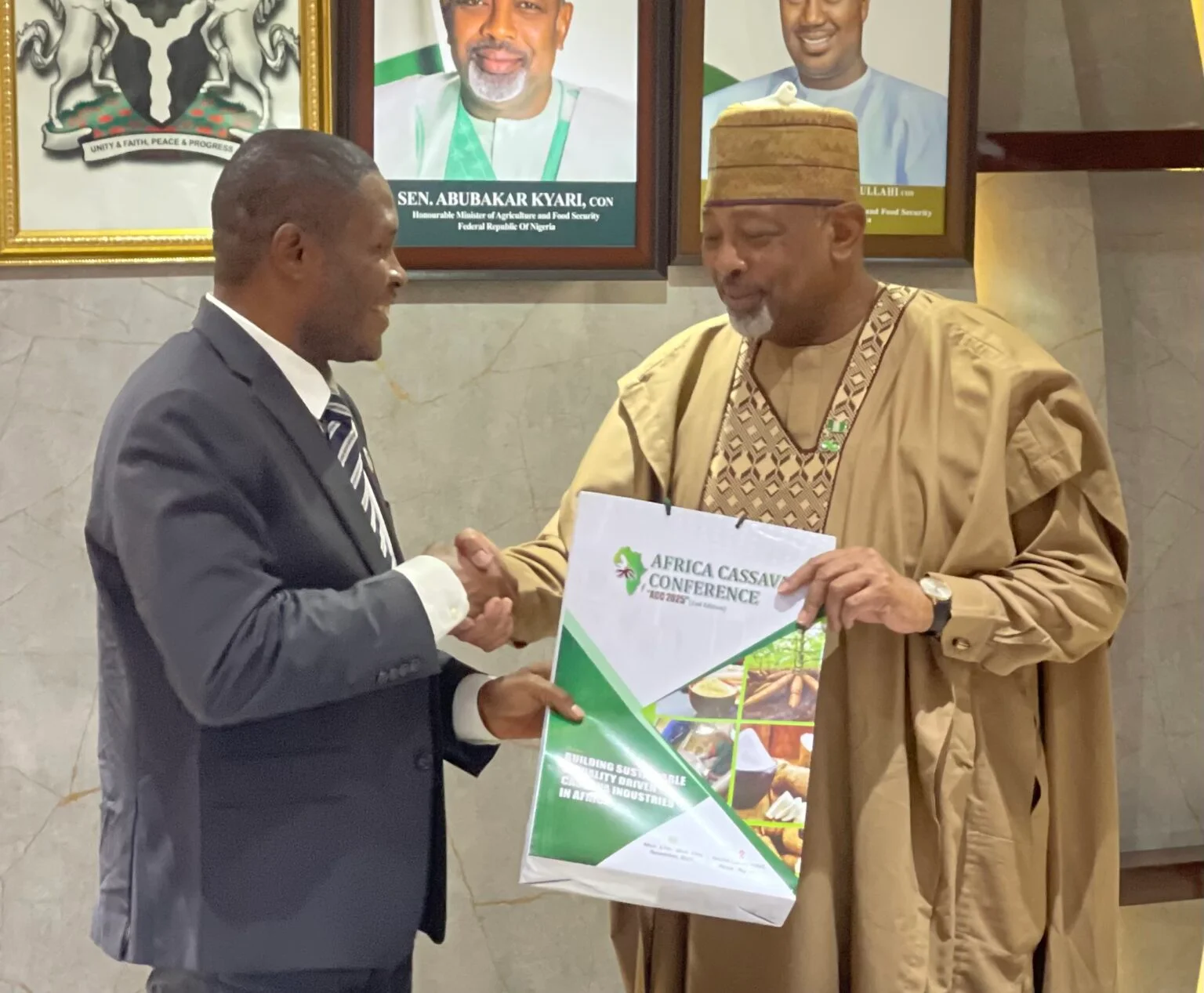
The decision was reached at a roundtable meeting between the Minister of Agriculture, Sen. Abubakar Kyari, and the Director-General of PAOSMI, Dr Henry Emejuo on Thursday in Abuja.
The partnership will focus on cassava, soybean, ginger, and sesame value chains.
In his remarks, Emejuo highlighted ongoing interventions across the cassava, sesame, and ginger value chains and said the initiative aligns with PAOSMI’s AU Agenda 2063 Community Activation Project (AU-CAP).
He explained that PAOSMI is a private sector-driven network operating in 40 countries, aimed at advancing industrialisation across agro value chains by activating community-based enterprises for continental growth.
“The time has come for stakeholders to stop working in silos and ensure synergy and coordinated activities for continental growth,” he said.
Emejuo called on stakeholders to deepen engagement on cassava industrialisation to boost people’s wealth, following the successful African Conference on Cassava.
He also urged the speedy passage of the High Quality Cassava Flour (HQCF) Bill in the Senate, which seeks to mandate 20 per cent inclusion of cassava flour in pastries, among other provisions.
Also speaking, Dr Lawal Buga, Director at PAOSMI, said cassava remains a flagship value chain due to its importance for food security, industrial raw materials, and rural employment.
Buga outlined key actions for cassava, including promotion of industrialisation, HQCF, starch, ethanol, sustainable aviation fuel, sweeteners, bio-inputs, and animal feed.
He stressed that farmers should be aggregated, SMEs engaged, and processing clusters developed, while private sector players; including processors, industrial off-takers, aggregators, and investors are closely involved.
This, he added, will strengthen demand-driven production and cut post-harvest losses.
On sesame and ginger, Buga said PAOSMI is advancing them as priority export crops by ensuring quality compliance, traceability, and integration of SMEs and cooperatives into regional and international markets to increase foreign exchange earnings and rural incomes.
He explained that AU-CAP serves as PAOSMI’s framework for translating Agenda 2063 into community-level economic outcomes, focusing on agro-enterprise-led activation, youth and women inclusion, and linking production to processing, markets, and finance.
Responding, Kyari expressed delight at PAOSMI’s interest in cassava industrialisation.
He said the ministry, in collaboration with partners, is already working to boost production to meet both local and export demand.
Kyari noted Nigeria’s partnership with Saudi Arabia requires production of 1.2 million tonnes of soybean, in addition to the local demand of 2.4 million tonnes.
Read Also: APC Conflict Resolution, Strategy and Mobilisation Committee…
“We look forward to extensive collaboration. Let us draw a timeline so we know what we want to achieve. I will also request the Chairman of the Nigeria Cassava Growers Association to join to form a Public Private Partnership (PPP),” he said.
Earlier, Dr Tony Bello, Chairman of Shine Bridge Incorporated, a U.S.-based agricultural policy think-tank, emphasised that stakeholder synergy, policy reforms, and science-driven food technology innovation are key to boosting local consumption and sustainable export growth.
Dr Mustapha Dan-Kano, Chairman of the Nigeria Cassava Growers Association, said cassava production is the foundation of industrialisation for food, fuel, and energy.
He highlighted that cassava waste, which could be used to generate energy, is currently being lost.
He pledged to upscale cassava farmer data to coordinate the collection and processing of peels and other residues, potentially solving about 80 per cent of the sector’s challenges.
