
Ojokoro LCDA reaffirms commitment to environmental sustainability

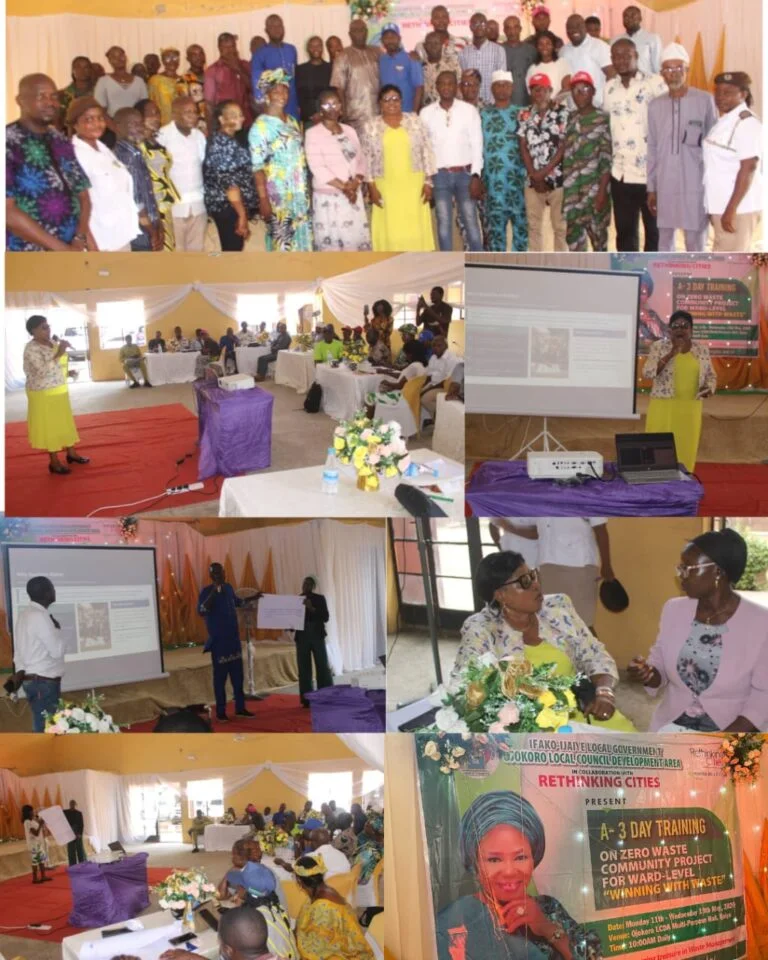
Ojokoro LCDA reaffirms commitment to environmental sustainability
The Chairman of Ojokoro Local Council Development Area (LCDA), Mrs Oluyemisi Rosiji, reaffirms commitment to environmental sustainability and cleanliness in the area.
Rosiji said this during a three-day Zero Waste Community Project training held at the Ojokoro LCDA Hall.
The training, titled “Winning With Waste”, started on Monday and ended on Wednesday.
It featured group discussions, presentations and interactive sessions on sanitation and waste management.
It was facilitated by Rethinking Cities, Nigeria Social Insurance Trust Fund (NSITF) and Green Hub, groups that focus on recycling and environmental education.
The chairman said the programme was to equip residents with simple waste management solutions through practical sessions and group work.
Rosiji highlighted the urgent need for proper waste disposal culture.
She warned against indiscriminate waste dumping and blockage of drainage channels, while noting the economic value of plastics generated during social gatherings.
Read Also: Emir’s Cup draw holds in Gombe as organisers rally stakeholders
According to her, “Waste should no longer be seen as useless refuse but as something valuable that can create opportunities.”
The chairman assured residents of the council’s support and readiness to work for a cleaner and safer Ojokoro LCDA.
Mr Deji Akinpelu, Director of Rethinking Cities, trained participants on circular economy and cooperative governance.
“We are here to show residents practical ways of turning waste into wealth,” he said.
Akinpelu said recycling and reuse could create income and urged communities to adopt clean environmental habits.
Mr Ayuba Salami, an NSITF facilitator, trained participants on household practices, including waste separation, composting of food waste and the cash-it model.
“Household participation is key. Separating waste at home helps recycling and reduces waste in communities,” he said.
Ms Arafat Sorunke of Rethinking Cities explained basic studies, including how to sample waste, weigh it, plan sanitation and work with local leaders.
“Communities must study their waste patterns before planning proper sanitation strategies,” she said.
Mr Musab Is-haq of Unilag Green Hub trained participants on community waste monitoring, focusing on Lagos conditions, safety and waste types.
“Community waste monitors help identify waste types and ensure safe handling of waste in cities,” he said.
A participant, Alhaji Suleiman Adama, General Secretary of Waste Pickers Association, Abuja, said he would launch awareness campaigns on waste opportunities.
Adama said he would apply the new methods in his community and expand campaigns to involve more people in waste management.
“We will start small composting programmes to produce organic fertiliser and document the process for others to learn,” he said.
Mr Eugene Yakubu, another participant and freelance researcher, said he learnt composting methods and circular economy ideas.
He said informal waste workers must be involved and properly recognised.
Yakubu called for waste separation, recycling and reuse, noting that informal workers played key roles in spite of social stigma.
Another participant, Mr Femi Owoeye of Trashmonger Ltd., Abuja, said organic waste accounted for about 70 per cent of daily waste.
He advised: “Start small with local composting projects.”
Owoeye said the session on turning organic waste into fertiliser was helpful and urged communities to apply what they learnt before seeking bigger support.
Mrs Adeboye Olufunke, a retiree, said the training showed the benefits of cleaner communities and job creation.
She said: “Trash can truly become treasure.”
Olufunke said she learnt how to sort waste, make compost and use safety items like gloves, nose masks and boots.
Mrs Oluwakemi Jolaoso, a fashion designer, said she learnt better ways to handle household waste.
She said: “I came to learn more about waste management to improve my income.”
Jolaoso said recycling could help people earn money.
