
Food Security: Abia Govt. to support only registered farmers in the state

Food Security: Abia Govt. to support only registered farmers in the state
Gov. Alex Otti of Abia has warned that his government will not support any farmer who fails to be captured and registered in the database designed for farmers in the state.
Otti gave the warning on Friday while
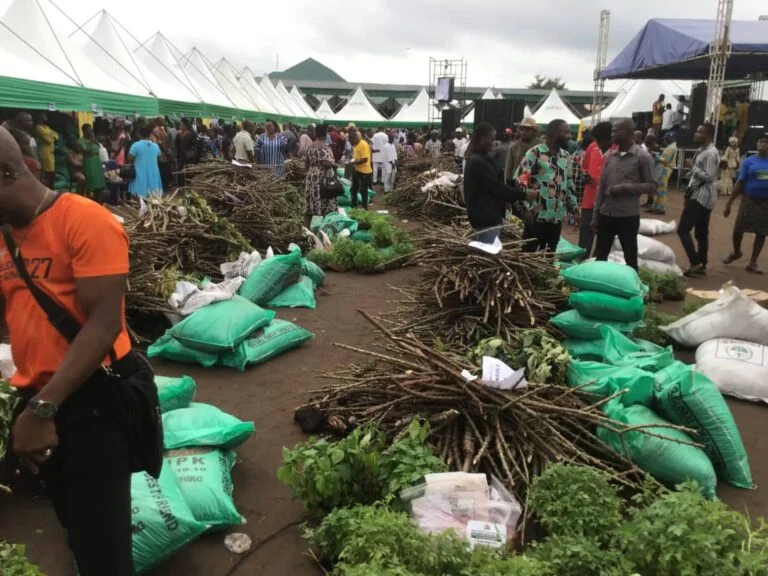
inaugurating the Abia Farmers Input Support Programme held at the Umuahia Township Stadium.
The governor said the project was aimed at encouraging large scale food production and commercial farming to ensure food security in the state.
He said that subsistence farming was still useful but won’t take the state far.
He said the state was providing the inputs and also the transportation for conveying them to ensure that farmers do not incur unwarranted expenses.
The State Commissioner for Agriculture, Dr Cliff Agbaeze, said government support to farmers in the 17 local government areas of the state was to boost food production in the 2026 farming season.
He said that a total of 18,000 farmers from 184 wards in the state would be supported.
He added that 3,312 farmers would benefit from the input distribution at the event.
Agbaeze said the remaining farmers would receive their inputs at their local government headquarters at a later date.
He listed the items distributed to the farmers to include rice and tomato seedlings, cassava stems, pepper seedlings, maize, plantain suckers and potato vines.
Others are bags of NPK fertilizers, Organic fertilizers, herbicides and pesticides to ensure their efforts are productive.
The Keynote Speaker, Prof. Chiedozie Egesi, the Executive Director, National Root Crop Research Institute, (NRCRI) Umudike, Umuahia, lauded the idea of supporting farmers with inputs.
He said the programme was a declaration that agriculture had taken its priority in Abia and that the Abia Government was building a safe state for the future.
“When leadership is purposeful, development follows; when the government provides an enabling environment, businesses grow and
when farmers are empowered the economy prospers,” he said.
Egesi said that Abia had been and could again become the agricultural capital of Nigeria being the hub of oil palm, cassava and other crops.
Read Also: Spain edge Belgium 2-1, reach semifinals
He said that root and tuber crops are the backbone of agriculture in Abia as an employment, industrial and economically valuable crop.
He said that the NRCRI was ready to partner the state to ensure proper development of agriculture.
The executive director lauded the state government for establishing a database for the registration of true farmers.
He said this would make planning easier and help the genuine farmers to receive the deserved assistance.
Egesi urged Abia farmers to continue keeping and updating their data to ensure they accessed more assistance in the future, noting that the future of agriculture was bright.
Also speaking, the Vice-Chancellor, Michael Okpara University of Agriculture (MOUAU), Prof. Ursula Akanwa, thanked the government for the initiative of supporting farmers with inputs.
“Agriculture is the bedrock of the Nigerian economy and remains the most reliable for ensuring food sufficiency and reducing poverty.
“Therefore, a programme as this, not only supports commerce but strengthens the entire agricultural value chain.
“It also creates employment opportunities and contributes significantly to socio-economic advancement of our communities,” she said.
Akanwa added that such policy initiatives translates into tangible benefits and urged the farmers to make judicious use of the inputs provided so the programme could yield the desired results.
One of the beneficiaries, Mr Ihemegbulem Chidiebere from Umunnekwu in Isiukwuato LGA told the News Agency of Nigeria (NAN) that the programme demonstrated the state governor’s vision of developing agriculture in Abia.
He thanked the governor for the gesture saying that Abia farmers have not experienced such support at this scale.
Chidiebere suggested that the programme be held between February and March every year to ensure the inputs find space in people’s farms rather than when the farming season was ending.
