
IMION DG blames inefficient logistics for blue economy losses

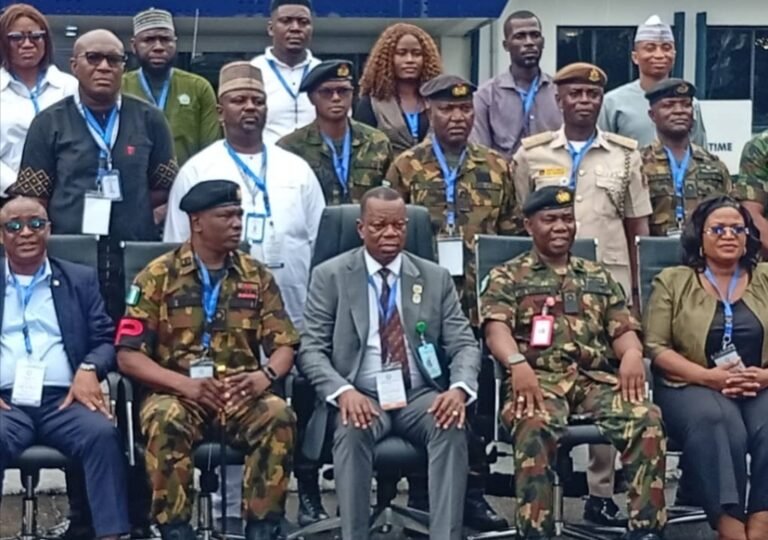
IMION DG blames inefficient logistics for blue economy losses
The Director-General (DG), International Maritime Institute of Nigeria (IMION), Rear Adm. Thaddeus Udofia (rtd), blames inefficient logistics is hindering Nigeria’s blue economy potential.
Udofia stated this on Monday in Apapa, Lagos, while declaring open a three-day executive training on “Logistics and Trade Facilitation for Blue Economy Growth”.
He said efficient logistics was crucial to unlocking Nigeria’s maritime resources, reducing business costs, strengthening supply chains and increasing competitiveness in international trade.
According to him, logistics drives between 80 and 90 per cent of global sea-borne trade and economic activities.
“The Blue Economy represents one of the most significant opportunities for sustainable growth, job creation, trade expansion and regional integration across Nigeria and Africa,” he said.
Udofia said the training was designed to facilitate the movement of goods and services within the blue economy ecosystem.
He added that it would promote national development by equipping participants with practical knowledge of maritime logistics and contemporary trade facilitation.
The IMION director-general said Nigeria had a coastline of about 420 nautical miles, equivalent to 853 kilometres, and an Exclusive Economic Zone extending 200 miles.
“Our maritime domain also includes inland waterways, creeks, estuaries and the Niger Delta basin.
“These assets constitute enormous economic potential for national prosperity and development,” Udofia said.
He, however, said transforming the assets into economic prosperity depended on efficient movement of people, goods, information and services.
Udofia identified logistics and trade facilitation as major challenges requiring urgent attention to maximise Nigeria’s maritime economic opportunities.
He said effective trade facilitation required collaboration among customs authorities, port operators, regulators, shipping companies, freight forwarders and transport operators.
Read Also: Yargote Foundation seeks NAN’s partnership for boy-child summit
He also listed technology providers and financial institutions among stakeholders whose cooperation was essential for an efficient maritime trade ecosystem.
Udofia called for increased collaboration, digitalisation, transparency and coordinated policy implementation to strengthen Nigeria’s blue economy.
He said the training would deepen participants’ understanding of modern logistics, customs procedures, port operations and multimodal transportation.
“It would also cover supply chain management and contemporary approaches to trade facilitation,” he added.
Udofia urged participants to share experiences, challenge existing practices and build networks capable of producing practical solutions to maritime-sector challenges.
He said solutions developed through the triple-helix concept could be ambitious while remaining practical and implementable.
Similarly, Prof. Ogochukwu Ugboma, Lagos State University’s School of Transport and Logistics, said blue economy components had little value without efficient logistics.
Ugboma added that information and financial flows were equally critical to facilitating the movement of goods and services.
Also, Dr Obiora Madu, African Centre for Supply Chain Management, said Nigeria loses huge sums annually because of inefficiencies at its ports.
Madu said ports should be viewed as strategic corridors, stressing that their efficiency was critical to reducing trade costs and improving competitiveness.
