
Kaduna’s child brides find path back to the classroom

Kaduna’s child brides find path back to the classroom
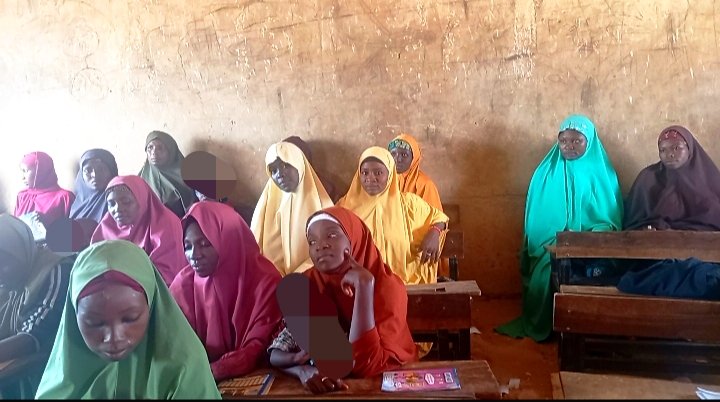
With a toddler on her lap, and a book resting on the desk before her, a young mother sits among other women in colourful hijabs.
In the modest classroom, the women listen attentively to their teacher, who reads a text on the blackboard, repeating after him.
For these married adolescent girls in Bugau, in Damau ward of Kubau Local Government Area, Kaduna, motherhood did not end their desire for education.
After being forced out of school by early marriage, they are now finding their way back to the classroom, determined to reclaim an opportunity they once lost.
They attend classes four times a week, learning how to read and write in Hausa and English, with classes starting at 8:30am and ending at 10:00am.
In Bugau, girls are married off as soon as they attain puberty.
It is a popular belief that education is for the boy child, while the girls are meant to marry, bear children and take care of the family.
“In our household, my family do not believe in educating girls. They only sent my brother to school. He has now finished secondary school and continues his education in a different town.
“When I asked why girls weren’t allowed to study, I wasn’t given a clear reason, but there was a general belief that educating girls was not useful and that it was only beneficial for boys,” Basira Isah, 15-year-old married adolescent, says.
Isah, who was married off at the age of 13 and relocated to Bugau, where her husband lives, said she was born and raised in Mabuga, a community near Bugau where she attended primary school.
However, her education was cut short at primary 3, not due to lack of teachers.
According to her, their teachers were not from their village, so they travelled from other places to teach them, mostly once a week, and eventually, they stopped coming; a situation which affected their education.
Instead of wandering around playing, Isah stayed home and helped her mother sell ‘kunu’ (a traditional drink) at the market to support the family.
She was later married off to a suitor chosen by her father, in spite of her resistance.
But Isah wasn’t the only girl with this experience.
Hadiza Danjuma is another married adolescent. She was married off at the age of 14 after dropping out of school in JSS 2.
She attended primary school in Bugau, the only school in the community, and later moved to Damau, a town about 10 kilometres from her community, to attend secondary school.
She said she met her husband when she was 13, when he revealed his intention to marry her, but she told him she wasn’t ready.
Unlike Isah, Danjuma courted her husband for one year before her father decided it was time to marry her off.
“In Bugau, honestly, not everyone finishes school; some only finish primary school.
“For those whose parents are resilient, and if the girls start school at an early age, they are the ones who might finish primary school, JS 1, or JS 2 before getting married,” she said.
Another married adolescent, Zainab Shehu, aged 14, said she was the first female child enrolled in school up to secondary school level.
But that would not be completed, as she was also forced to drop out at JSS 2 for marriage.
She met her husband while returning from school, where he showed interest in her, but she did not reciprocate.
Subsequently, the suitor went directly to her parents to reveal his intention for marriage and asked for her hand when she was just 12 years old.
“At that time, honestly, whenever a suitor came, I would just run away. I wasn’t interested in chatting with men.
“Even if you greeted me, I wouldn’t answer you, I would just pass by. And if anyone visited me at home, I would just say my greetings and sit down, that’s all.
“I wouldn’t talk to you; you’d just get tired, stand up, and leave,” she said, while smiling.
Beyond these individual accounts, the wider figures paint a sobering picture.
Early marriage remains a major challenge in Kaduna, especially in parts of the Kaduna North senatorial zone.
The 2021 Nigeria Multiple Indicator Cluster Survey (MICS) found that 45.3 per cent of women aged 20 to 49 in Kaduna had entered marriage or union before age 18, while 18.3 per cent had married before age 15.
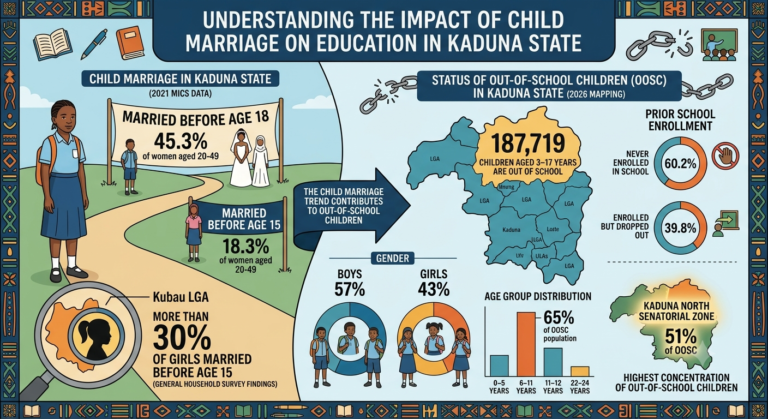
Findings from the Kaduna General Household Survey similarly showed that more than 30 per cent of girls in Kubau Local Government Area were married before age 15.
This trend has, in turn, contributed to the increased number of Out-of-School Children (OOSC) in the state.
According to the 2026 Kaduna State Out-of-School Children (OOSC) Mapping, 187,719 children aged 3–17 years are out of school across the state’s 23 Local Government Areas (LGAs).
The mapping showed that boys accounted for 57 per cent of the total, while girls constituted 43 per cent, with children aged six to 11 years representing 65 per cent of the identified population.
Of the total, 60.2 per cent had never enrolled in school, while 39.8 per cent had enrolled but dropped out.
Kaduna North Senatorial Zone accounted for 51 per cent of the state’s out-of-school children, making it the zone with the highest concentration.
It is against this backdrop that three married adolescent girls; Basira, Hadiza and Zainab, introduced a school for married women in their community.
This was after a non-governmental organisation, Participatory Communication for Gender Development (PAGED) Initiative, trained them on literacy and the importance of education.
PAGED Initiative is a non-profit, non-governmental organisation on a mission to foster inclusiveness and equity in every aspect of life in Nigeria.
It promotes participatory communication in society by ensuring that marginalised groups are understood and empowered, and that women and men are encouraged to work together towards achieving parity for all.
Their interaction with the NGO rekindled their desire for education, which made them champions in their community.
Read Also: Association urges content restrictions on free student data…
“After the meeting we had here, we saw that truly, education is very important for women.
“And we already had the desire, but due to our living conditions, there was nothing we could do but endure. Honestly, the arrival of this organisation renewed our hopes,” Zainab says.
With support from their husbands and the traditional leader of Bugau, these girls went house to house encouraging married women who had left school due to early marriage to return to school.
They got a teacher, who is also a resident of Bugau, to teach them how to read and write in English and Hausa.
This grassroots effort, in turn, found backing from the community’s traditional institution.
Malam Ibrahim Adamu-Bugau, the community leader of Bugau, said the PAGED Initiative had strengthened an effort being made by the community through the Bugau Educational Development Association (BEDA).
Bugau described the development as significant, especially because of its focus on girls and women who had been deprived of educational opportunities.
“All of them started school, but by God’s will, as rural people, they couldn’t complete even secondary school. They were married off, and now each of them has given birth,” he said.
While early marriage was viewed differently from a religious perspective, the practice of marrying girls while they were still in secondary school could limit their educational opportunities and development.
Nonetheless, the community leader supported the initiative by allowing the girls to study in his house.
This, however, was just a short-term solution, as the students increased, and the leader’s house could no longer accommodate them.
He said the community was considering ways of providing exercise books, writing materials, whiteboards and books to support the women’s learning.
“As a teacher myself, we are considering how to supply basic materials, whiteboards, writing tools, and books that they can use to learn writing and reading,” he said.
Finding a suitable learning environment for the women has, in fact, been one of the challenges facing the programme.
The students moved out of the traditional leader’s house to an Islamic school near the primary school, but had to leave after the school management was not receptive to the arrangement.
They later used the premises of a government primary school, but a scheduling conflict arose because the government pupils and the adult learners needed the same space at the same time.
Another Islamic school in the town was then identified, although the women can only use it during the school’s vacation period.
As a result, Adamu-Bugau said the community was therefore considering how best to structure the timetable so the women could continue learning without disrupting the regular activities of the schools.
There is also a need for additional teachers as the number of learners increases, since having more than one teacher could also improve learning, because teachers could complement one another in subjects where they had different strengths.
In spite of these challenges, the programme, which began in February, had recorded significant progress within two to three months of its commencement.
Some of the women who did not know the English alphabet can now identify and even spell their names.
For Habiba Ibrahim, 21, the opportunity came after she had already become a wife and mother.
Habiba completed primary school and wanted to continue to secondary school, but said customs in her village prevented her from doing so, and she was eventually married.
One year ago, however, she returned to learning after a friend told her about an adult literacy school.
She sought her husband’s permission to join, and he agreed.
Since then, Habiba said she has noticed a significant change in her ability to read and write.
“Before, I couldn’t read Hausa properly. But now, Alhamdulillah, I can write and read,” she said.
The improvement has translated into simple but important changes in her daily life.
When her children are sent to the shop to buy household items, Habiba said she can now write down what she needs and send the list with them.
For another participant, Asiya Muhammed, who has been married for five years, the opportunity represents a chance to acquire skills she missed earlier in life.
She said they were learning how to write, read, spell words and recognise numbers.
The ability to use a phone has also become an important measure of their progress.
Previously, she said, women who could not read had to rely on younger relatives to identify phone numbers and tell them who had called.
“Anytime I see someone speaks English, I feel motivated; that’s why I ensure I come to school so that one day I can also speak good English,” she said.
According to her, women have also learned to organise their time between education, trading and household responsibilities.
She argued that educating women has implications for children’s education, because mothers are often the ones helping their children at home.
Muhammad said that she missed out on education in her youth and was determined to ensure her children do not make the same mistake.
She encouraged them to attend school rather than spend their time playing or engaging in street hawking.
Ultimately, for Ibrahim and the other women, the ability to read a phone number, write a shopping list or help a child with schoolwork may appear small.
But after years without access to education, they see these everyday abilities as evidence that learning can still change the course of their lives.
