
Knowledge Over Oil: TETFund Boss Urges Radical Shift to Research and Innovation at OAU 65th Anniversary Lecture

Knowledge Over Oil: TETFund Boss Urges Radical Shift to Research and Innovation at OAU 65th Anniversary Lecture
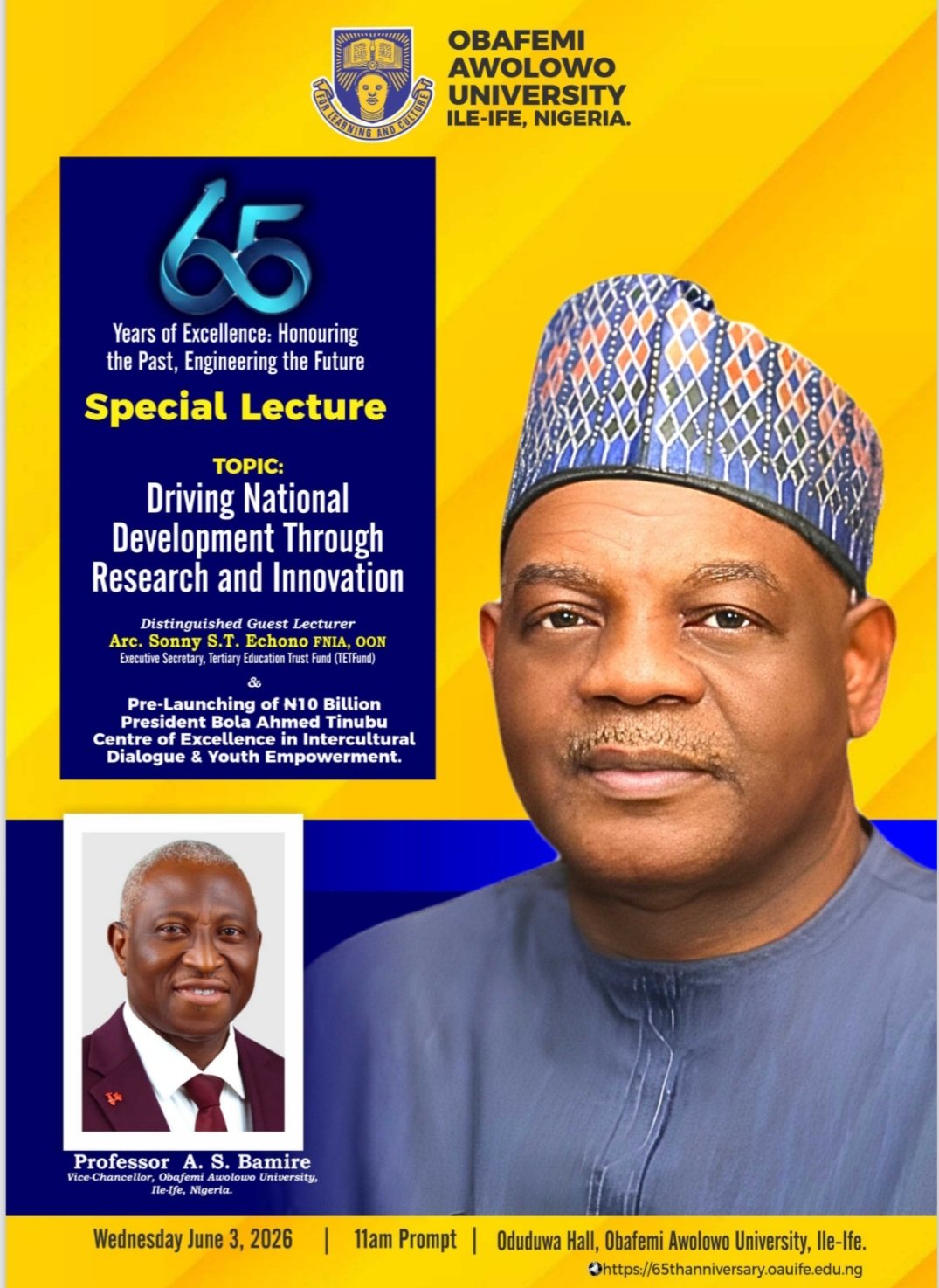
The Executive Secretary of the Tertiary Education Trust Fund (TETFund), Arc. Sonny S. T. Echono, has asserted that Nigeria’s future, competitiveness, and long-term stability depend entirely on shifting away from natural resource extraction and toward a knowledge-and-innovation-driven economy.
Delivering a lecture at the 65th anniversary celebration of Obafemi Awolowo University (OAU), Ile-Ife, Echono emphasized that the country’s complex socioeconomic challenges, ranging from unemployment and insecurity to food crisis and infrastructure deficits, require deep, deliberate investments in research and practical technologies rather than academic theories.
Reflecting on the milestone anniversary of OAU, initially established in 1961 as the University of Ife before being renamed in 1987 to honor Chief Obafemi Awolowo, Echono praised the institution’s evolution from five faculties to a massive academic powerhouse housing 15 faculties, 118 departments, and over 32,000 students.
He commended the current Vice Chancellor, Prof. Adebayo Simeon Bamire, for providing focused leadership and bridging the gap between academia and the wider community.
However, he noted that the university’s milestone theme, “Legacy of Excellence – Future of Impact,” must serve as a broader call to action for higher education across Nigeria to turn intellectual output into tangible societal progress.
Echono argued that the traditional economic model of relying heavily on crude oil has structurally weakened Nigeria’s development by divorcing universities from national planning and leaving industries dependent on foreign expertise.
For decades, research in Nigerian tertiary institutions has remained locked within an academic silo, driven primarily by the need for promotional publications rather than commercialization.
This disconnect means that high-potential research outcomes routinely sit forgotten on library shelves while the local market starves for data-driven, homegrown solutions.
To bridge this deep systemic divide, Echono pointed to the “Triple Helix” model of innovation, which mandates dynamic cooperation among universities, industry, and the government.
He highlighted several critical obstacles currently choking Nigeria’s research ecosystem, noting that the country spends less than one percent of its Gross Domestic Product (GDP) on research and development.
This lack of financial backing is compounded by outdated laboratories, erratic power supplies, institutional policy inconsistencies, severe data management gaps, and ongoing regional insecurity that disrupts crucial field research.
Furthermore, the persistent phenomenon of “brain drain” continues to sap institutional capacity as experienced scientists and educators migrate abroad for better working conditions.
Despite these hurdles, the TETFund boss highlighted targeted areas of progress, such as local agricultural breakthroughs from institutes like the International Institute of Tropical Agriculture (IITA) and the meteoric rise of Nigeria’s financial technology sector.
He noted that TETFund has shifted its intervention paradigm beyond physical brick-and-mortar infrastructure toward aggressive funding for intellectual capacity and commercialization frameworks.
Through its National Research Fund (NRF), the agency actively finances cutting-edge projects across science, technology, humanities, and social sciences.
Concrete outcomes of this new direction include the TETFund Alliance for Innovative Research (TETFAIR) and the Research for Impact (R4i) programs. Together, these initiatives have birthed over 200 functional prototypes, including an affordable, self-programmable hearing aid specifically optimized for the African market, which recently won international acclaim at a medical conference in Israel.
To ensure these innovations do not stagnate, TETFund introduced the Commercialization Innovation Fellowship (CIF) to transition successful prototypes into scalable, market-ready businesses.
Read Also: Police Foil Bandits Attack, Recovers 25 Rustled Cattle In Sokoto…
Operationally, the intervention agency has also focused heavily on institutional capacity building and physical research infrastructure.
Between 2019 and 2022, TETFund sponsored 1,761 academic staff for international workshops on grant writing and management, a curriculum subsequently decentralized across Nigeria’s six geopolitical zones to create a critical mass of research-driven faculty.
Structurally, the fund has established 30 initial Centres of Excellence—including two at OAU—and recently added six more specializing in advanced frontier fields like Robotics, Artificial Intelligence, and Cybersecurity.
To domesticate complex laboratory analysis and end the costly reliance on foreign institutions for scientific “benchwork,” TETFund is currently completing six Multipurpose Zonal Laboratories outfitted with world-class equipment.
Additionally, the fund is setting up 45 Innovation Hubs and 60 ICT Experience Centres across the country to improve graduate employability and bring modern digital infrastructure directly into the learning experience.
International alliances are further expanding this domestic push. TETFund has forged strategic partnerships across the globe, recently signing a Memorandum of Understanding (MoU) with the United Nations Development Programme (UNDP) to operationalize local innovation hubs.
The fund has also sustained sponsorship for the Israeli Embassy’s Innovation Fellowship for Aspiring Inventors and Researchers (i-FAIR) program, helping dozens of Nigerian scholars secure patents and transform into active economic entrepreneurs.
Expressing gratitude to President Bola Ahmed Tinubu for his administration’s focused commitment to educational reform, Echono concluded by emphasizing that building an innovation-driven economy requires sustained, coordinated national willpower.
He maintained that Nigeria’s path to lasting development relies entirely on how effectively it can weaponize knowledge and technology to expand opportunities, generate employment, and elevate the overall well-being of its population.
