
NGF advocates coordinated strategy, data-driven solutions to bridge rice production deficit

NGF advocates coordinated strategy, data-driven solutions to bridge rice production deficit
The Nigeria Governors’ Forum (NGF) has called for a coordinated, data-driven approach to bridge Nigeria’s rice production deficit and boost national food security.
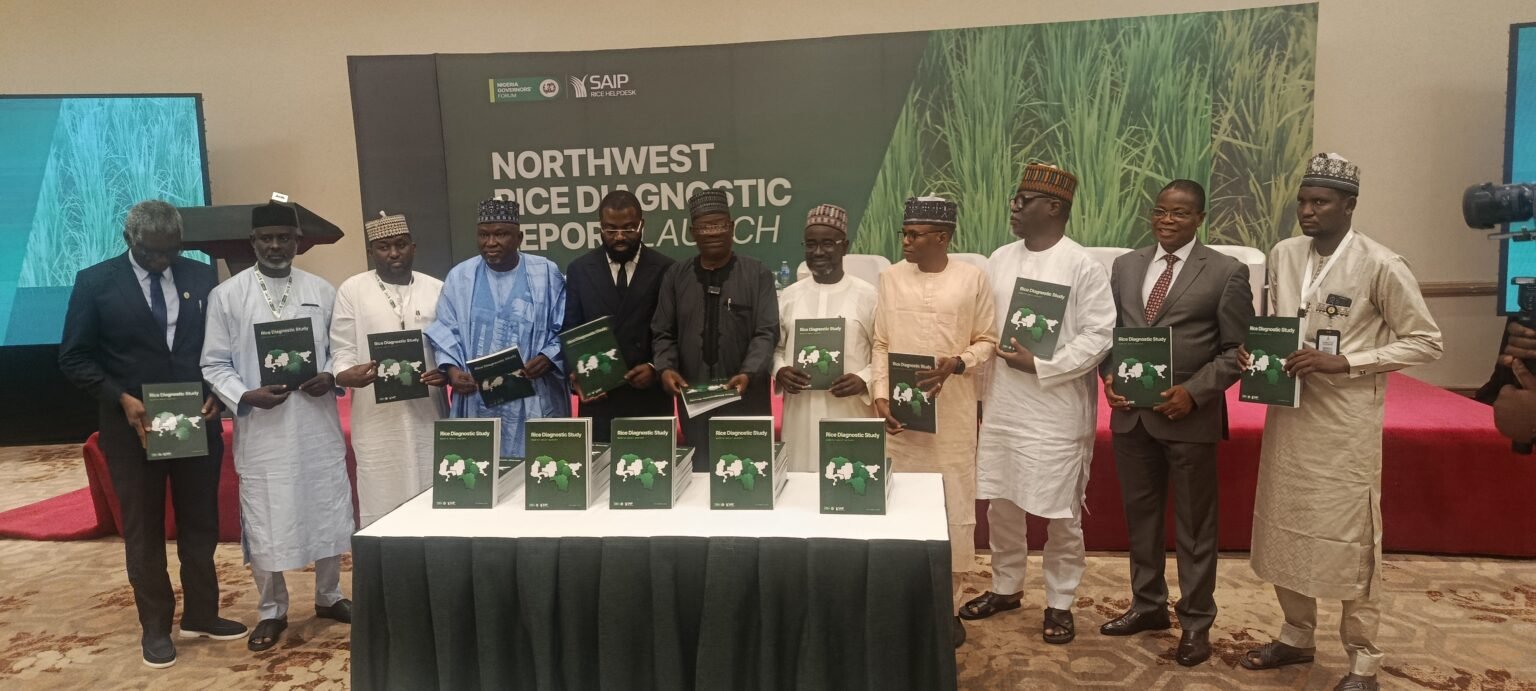
The NGF Director-General, Abdulateef Shittu, made the call in Abuja on Wednesday at the unveiling of the “North-West Region Regional Rice Sector Diagnostic Report”.
The report was produced by the State Agribusiness Investment Programme through the NGF Rice Helpdesk, supported by the Gates Foundation.
Shittu said available data indicates that Nigeria consumes approximately 8.6 million metric tons of rice annually, a figure projected to reach 9.1 million by 2027, against domestic production of 3.3 million metric tons.
He attributed the deficit to policy flip-flops, poor budgeting, and lack of accurate data, adding that data was central in the development of any sector.
“Data is central to everything. A friend of mine said data is the next oil. It is the oxygen that drives and propels development,” Shittu said.
He advised Nigeria to draw lessons from international models such as China’s agricultural self-sufficiency drive, saying that Nigeria has the potential to supply global markets.
“There is no reason why Nigeria cannot be a net exporter of rice to African countries and even parts of Europe. We have the land and the resources; we just need to coordinate our efforts,” he added.
Shittu noted that the NGF Helpdesk has set up a dedicated data department and was encouraging every state to establish its own Bureau of Statistics, alongside partnerships with institutions such as the International Institute of Tropical Agriculture.
Also speaking, the Managing Director of the Bank of Agriculture (BOA), Mr Ayodeji Sotinrin, said that the bank had a target to finance 700,000 farmers in 2026 wet season, up from 500,000 in 2025, while shifting away from direct cash distribution.
“We have stopped giving direct cash microcredits to farmers to eliminate non-performing loans and prevent defaults,” Sotinrin said.
On mechanisation, Sotinrin revealed that BOA had invested nearly one billion dollars into tractorisation to bridge the national equipment deficit.
“We are expecting 4,000 high-capacity tractors that will allow us to mechanise at least 2.4 million hectares of farmland.
“These will not be handed out to politically connected individuals but deployed through service providers,” he assured.
On his part, the Director-General of the Rice Processors Association of Nigeria, Dr Andy Ekwelem, cited poor farmer identification, fake inputs, high energy costs, and rural insecurity as major challenges for commercial millers in the North-West states.
Read Also: Yobe Govt intensifies supervision of ongoing infrastructure…
Ekwelem urged federal and state authorities to deploy verified farmer registers, supply certified seeds and fertilisers, undertake soil testing, and secure major agrarian corridors, particularly in Kaduna, Katsina, Zamfara, and Sokoto states.
He also called for government interventions on operational overheads, warning that domestic processors cannot compete favourably against foreign imports backed by decades of state subsidies.
The representative of the Alliance for a Green Revolution in Africa, Mr Phillip Obosi, cautioned that regulatory inconsistency risks stifling private capital.
Obosi noted that Nigeria’s projected 2026 rice imports of 2.9 million metric tonnes (1.4 billion dollars) represent a massive drain on foreign reserves that domestic production could easily conserve.
He urged governments to translate the report’s recommendations into budgetary allocations and actionable field programmes for input dealers, smallholders, and mechanisation providers.
