
NAN Editor seeks strong Africa-China media cooperation to change global narrative

NAN Editor seeks strong Africa-China media cooperation to change global narrative
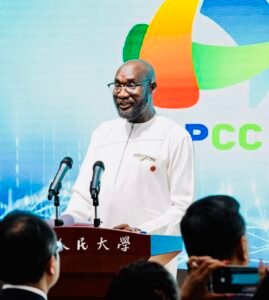
Mark Longyen, a News Agency of Nigeria (NAN) Editor, has urged journalists and media organisations from China, Africa, and the entire Global South to strengthen cooperation toward changing the global media narrative.
He made the appeal in a speech on behalf of journalists from the Global South at the opening ceremony of a 4-month training programme for journalists, on Tuesday, in Beijing, China.
NAN reports that about 100 foreign journalists from 100 countries are participating in the training, organised by the China Public Diplomacy Association (CPDA), and the China International Press Communication Centre (CIPCC).
“Journalists from the Global South must cooperate more through cross-border reporting, professional exchanges, fact-checking partnerships, and platforms where we speak to each other directly.
“Going forward, we must give the Global South a stronger voice in global affairs, and become authors of the global narrative, not just consumers of it,” he said.
He stressed that journalists from developing countries must also embrace new technologies, including artificial intelligence, while protecting the core values of journalism, which include accuracy, independence, ethics, and public trust.
Longyen said Africa had often been presented globally through a “narrow lens of conflict, poverty and crisis,” while China has often been portrayed through “simplified narratives that ignore complexity.”
According to him, there is a need for more African journalists to be telling African stories about China, and more Chinese journalists telling Chinese stories about Africa.
He challenged fellow participating African journalists to go beyond stereotypes, and report the successes, challenges, disagreements, and most importantly, the human stories behind China-Africa relations.
“We are also living through a profound shift in the global information environment. The world is becoming more multipolar — economically, politically, and culturally.
“Yet the global media system does not always reflect that reality. This programme, therefore, provides a veritable platform for dialogue between China, Africa, and the wider Global South,” he said.
The only Nigerian representative at the training said journalists are, ultimately, bridge-builders, who help to advance and promote people-to-people diplomacy, which no official document can achieve.
He said that an African journalist, who learns Chinese language, speaks with Chinese people and understands Chinese history, would return home with nuance.
Read Also: Buni inaugurates Yobe Media Summit, cautions against…
Similarly, he said, a Chinese journalist, who spends time in African communities, would tell richer and more accurate African stories.

“As participants, we have a responsibility beyond these four months. We must become bridges, not walls. Listeners, not merely speakers. Storytellers who connect, not divide.
“When we return home, we will carry more than certificates. We will carry new knowledge, new professional relationships, new questions, and a deeper understanding of one another.
“We hope our reporting will help our audiences see China, not just as it is portrayed, but as we have experienced it in all its achievements, complexities, opportunities and challenges,” he added.
He expressed hope that the training would also provide a platform for dialogue between China, Africa, and the Global South.
As journalists, he said, the participants came to China with open minds, ready to learn, engage, and share their experiences.
“We want to understand China’s development story, its economy, culture, technology, diplomacy, and media landscape from the inside.
“We want to travel beyond the headlines, meet ordinary Chinese people, visit institutions and communities, engage experts and officials.
“We want to see for ourselves both the opportunities and the challenges of China’s renowned remarkable transformation,” he said.
He further said the participants’ job was not to repeat what they were told, but to observe, investigate, verify, and tell stories that would help their audiences make sense of a changing world.
The foreign affairs editor said China-Africa relationship was one of the defining stories of the 21st century, with the partnership entering a new phase, especially with China recently unveiling a zero-tariff trade policy for African exports.
“Africa and China are mutually intertwined for shared prosperity, so understanding each other has never been more important.
“Our relationship must be clearly understood as being based on mutual interest and mutual responsibility,” he added
