
Vocational, technical education pathway to employment, economic growth – Sanwo-Olu

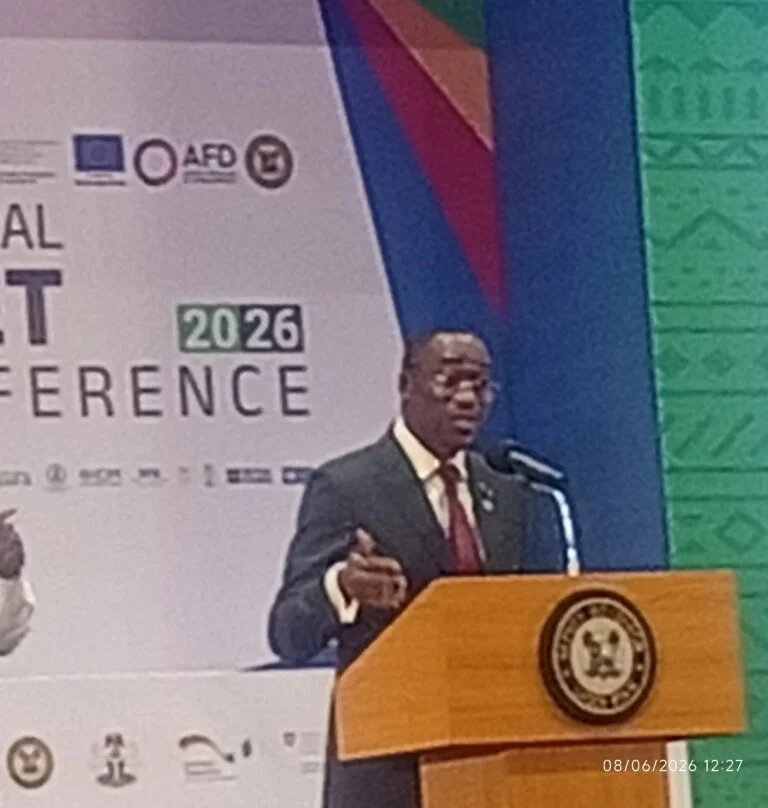
Vocational, technical education pathway to employment, economic growth – Sanwo-Olu
Gov. Babajide Sanwo-Olu of Lagos State, on Monday, described technical and vocational education as a strategic pathway to employment and sustainable economic growth in Nigeria.
Sanwo-Olu made the assertion at the 2026 National Technical and Vocational Education and Training (TVET) Conference held at the Lagos Continental Hotel.
Voice Media Trust (VMT NEWS) reports that the conference had the theme: ”Harnessing TVET as a Pathway to Employment: Building One System for Employability, Inclusion and Green Growth in Nigeria”.
The governor was represented by his Deputy, Dr Obafemi Hamzat.
He said that skills development remained central to unlocking the productive capacity of the people.
Sanwo-Olu said the theme of the conference addressed the urgent need to prepare Nigerians, especially youths, for a rapidly-evolving global economy.
He said that unemployment and under-employment persisted not due to lack of talent, but because of a disconnect between education and labour market needs.
He stressed the need for an education system that would produce job creators, innovators and problem-solvers.
“TVET is not a second choice. It is a smart choice. It is a pathway to dignity, productivity, entrepreneurship, and economic empowerment.
“Society must move away from over-emphasis on certificates and recognise the value of practical skills,” he said.
The governor said Lagos had supported its commitment with tangible investments through the Lagos State Technical and Vocational Education Board.
According to him, the board currently trains over 10,000 students annually across five government technical colleges in fields such as engineering, construction, information and communication technology, and creative trades.
He said: “More than 3,300 students were placed in industries under the Student Industrial Work Experience Scheme in the past year.
“Also, over 500 partners, including development agencies and private firms, are supporting curriculum development, equipment provision and instructor training.”
Sanwo-Olu added that about 70 per cent of graduates transitioned into employment or self-employment, while 85 per cent of participants in the state’s Skills for Work programme had secured jobs or started businesses.
He noted 23 per cent increase in female enrolment in male-dominated trades.
He emphasised that beyond economic gains, skills development would help to reduce poverty, promote inclusion and strengthen social stability.
Read Also: Unsafe food causes more than 53,000 deaths annually – FG
Earlier, Mr Jamiu Tolani Alli-Balogun,
the state Commissioner for Basic and Secondary Education, said that the government had consistently prioritised skills development as the cornerstone of long-term economic sustainability.
“TVET is no longer an alternative pathway; it is a strategic pathway. It is the bridge between education and industry, between learning and earning, and between potential and productivity,” he said.
The commissioner was represented by Mrs Victoria Peregrino, the Chairman, Lagos State Teaching Service Commission.
He identified employability, inclusion and green growth as critical areas requiring urgent attention.
The commissioner highlighted the importance of aligning technical education with emerging opportunities in the green economy, such as solar installation, waste recycling, sustainable construction and climate-smart agriculture.
He, however, said that the state could not drive the transformation alone, calling for stronger collaboration among the government, private sector and training institutions.
He assured teachers and instructors of the government’s commitment to their improved welfare, continuous training and provision of modern tools to enhance teaching and learning.
Addressing students, the commissioner emphasised the importance of skilled labour.
“The dignity of labour has returned. The era where skills were considered inferior to certificates is over.
“Whether you are a coder, a welder, a fashion designer or a solar technician, Nigeria needs you,” he said.
The commissioner stressed the need to align curriculum with labour market demands, modernise training facilities and ensure continuous professional development for instructors.
Mrs Moronke Azeez, the Executive Secretary, Lagos State Technical and Vocational Education Board, urged government to build more technical colleges.
Azeez also said the colleges should be equipped with modern facilities to strengthen dual education models, deepen industry partnerships, and ensure that students would acquire real, practical, and industry-relevant knowledge.
“We must make technical education a respected, attractive and deliberate pathway.
“Our responsibility is to ensure young people do not leave school empty-handed; they must leave with competence, confidence and a clear pathway.”
